
CATS: THE JELLICLE BALL
Music by Andrew Lloyd Webber
Based on Old Possum’s Book of Practical Cats
by T.S. Eliot
Choreographed by Omari Wiles & Arturo Lyons
Directed by Zhailow Levingston & Bill Rauch
Broadhurst Theatre
Official Website
and
MASQUERADE
Music by Andrew Lloyd Webber
Lyrics by Charles Hart
Additional Lyrics by Richard Stilgoe
Book by Stilgoe & Webber
Masquerade NYC / 218 West 57th Street 10019
Official Website
Reviewed by David Spencer
I have, I suppose, a healthy enough respect for Andrew Lloyd Webber, and have taken some consistent pleasure in some of his stuff—Evita and School of Rock in particular—but without getting into the weeds, neither Cats nor The Phantom of the Opera are…well, I was about to type “not for me” but that’s not strictly speaking accurate…and I won’t get into the weeds of why, because they’re within the category I call “force of nature” shows: audiences take to them in spite of received traditional principles. The Euro-musical sub-category they represent is typified by a combination of savvy programming, broad-strokes delivery, declamation almost entirely without subtext, and visceral impressionism. None of which I particularize as a put-down within that specific delivery system, because in the context, it’s idiomatic. And like any kind of musical theatre style that takes up territory in the literature, it’s of an era. Though unlike the others, its craft can’t be coherently codified, replicated or, so it seems, carried forward. It is, I think, significant that post-Miss Saigon, all attempts at the Euro-musical style have failed, usually spectacularly; and I think that’s because the style is so extreme that it had no place to develop to.
So it’s not really mine here to review the current revivals of Cats and Phantom in terms of my sensibility…but yours! They’re not any more nor less possessed of the qualities I’ve described; just differently so. The first obvious clue is the retitling.
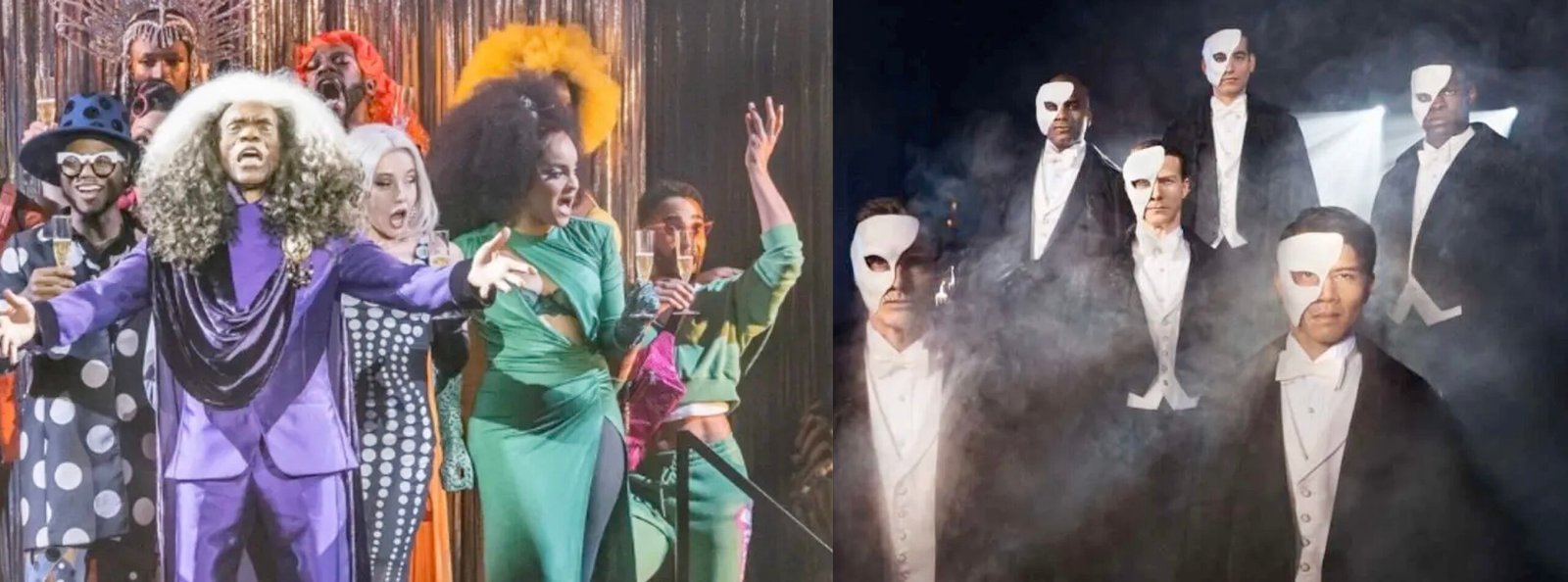
Cats is now The Jellicle Ball, and it no longer features “actual” felines, but attendees at a costume-competition ball that mandates they appear as cats; more specifically as cat characters, in outfits less explicitly animal-like than abstractly animalistic. bringing portraiture, backstory and exhibitionism to the literal party. That last, exhibitionism, is arguably the most important part of the conceptualization, because, with the contestant-guests being tacitly but consciously acknowledged as humans looking to outdo one another, open sexuality is a vital part of the mix: Breasts, pecs, butts; displays ranging from muscled flex to pulchritudinous joy-jiggle; attitudes ranging from You-Know-You-Want-It to Come-and-get-it. All in good fun, but with a touch of the illicit, as a police raid at the 3/4 mark is meant to underscore.
Narratively, it makes less sense than “Cats Pure,” but that’s not much of a caveat; and it seems best enjoyed by those who already know the show and the score, but after half a century, there won’t be many in attendance who won’t.
Masquerade is the reputedly interactive reworking of The Phantom of the Opera, and it is minimally interactive, in any sense of the audience affecting the proceedings, but where even this makes a profound difference is in how the production consciously acknowledges the presence of the audience.
Let me back up a bit for context. A characteristic of the mostly-through-sung Euro musical style is that its very few hits—all of which harken to when the style was new, that newness still endemic to their construction, which ios why they are lasting survivors—are entertainment machines. The confluence of declamatory text, BIG music, highly mechanized and precise staging, doesn’t elicit any communal behavior from the audience aside from applause for a song or dance well delivered—and there are designated pauses for that. But laughter? Recognition? Surprise at a revelation? Anything that might affect performance timing? Not so much. I’m not saying that if you’re among the countless millions of fans you don’t/won’t have an emotional response, obviously you do; nor am I saying that repeat-view fans and cast album collectors don’t thrill to the differences between, say, Michael Crawford & Sarah Brightman on the London and Colm Wilkinson & Rebecca Caine on the Canadian. However, the mechanism of every performance is the same: It appeals to the viscera, per its particular “science”, of those susceptible to it, and the performers may be brilliant; but they don’t have to be. They only have to be sufficient unto the task, because the energy of the machine is the star And because of that, ironically, the audience doesn’t really have to be present for it to function on a technical level. Schmigadoon, which depends upon recognition of musical theatre tropes, cannot function without the audience encouraging its antics; you would notice the difference as keenly as the actors on a night when “the house is dead.” A Euro-musical wouldn’t get a hair out of place.
Masquerade, conversely, cannot function without the audience. Staged at a former out house venue, now rechristened Masquerade NYC, on six floors, in rooms of various types and passageways between, through which the audience is expertly led, it forces the show and the audience to confront one another, and this is created an idiosyncratic intimacy. There are many moments in which the characters—at times within arm’s reach—see us, interact with us, solicit help with bits of business, nudge for an empathetic response. Even moments that, on Broadway, were just part of the theme park spectacle, are presented in such a way as to imply saying, “See? See what we did there? How did you like that?”
To be sure, there are unavoidable artifacts of the machine still present: the material is the material, and in this iteration, the orchestral accompaniment is pre-recorded. Having had much experience with creating and rehearsing to pre-recorded tracks, I can attest that this differently forces the performer to freeze his or her musical timing; even a moment that seems like a reaction pause is timed to strictly tempo’d beats. (The tracks can even feature subtle cues the audience isn’t even aware of to give the performer a countdown.)
But by and large, the environmental approach is—I won’t say better, necessarily, but—more human. And I think, for some at least, potentially more emotional. It was for me. And more narratively coherent. It still doesn’t entirely make sense, but the illusion of continuity is more convincing when you yourself are too actively involved to think about it. The production doesn’t make me inclined to forgive director Diane Paulus for her out-and-out head-slamming abuse of 1776…but it reminds me that she’s capable of much better. Not necessarily subtler; but better. The broad strokes of Webber’s Phantom are right in her wheelhouse.
The show is performed without intermission over approximately two hours. Each performance block, matinee or evening, contains six full-length “pulses,” staggered at 15 minute intervals. Each pulse takes in an audience group of around 60. Each audience follows its own Phantom-Christine-Raoul trio; yes, there are six. (That is, per night. Technically there are even more who can step in; for example, the 7:00 pulse I attended featured the dedicated “swing” Phantom-Christine pairing of Nkrumah Gatling and Nicole Ferguson.) Smaller roles are triple, double or single cast—playing their respective scenes, thrice, twice or six times, depending upon the logistics—over the course of an evening.
The guiding staff—who must be counted as part of the staging—cannot be praised highly enough, for efficiency and kindness, especially their attention to audience members with disabilities, who are guided to elevators rather than stairs, given cane-chairs for segments where audiences are meant to stand, and always positioned where the sight-lines are satisfactory-to-excellent. (I have to contrast this with the way I felt at Sleep No More, also interactively staged on multiple levels in multiple rooms, an experience I disliked, in part because the passive-guide staff struck me as unhelpful, snooty and even unwilling to let you leave when you’d had enough.)
Though I will always have reservations about the show as written, I can recommend that, for this experience of it, you make your reservation unreservedly.