
PROOF
by David Auburn
Directed by Thomas Kail
Starring Ayo Edebiri and Don Cheadle
Booth Theatre
Official Website
Reviewed by David Spencer
There’s a severe limit on what I can tell you about David Auburn’s Proof even 26 years after its debut, because I never like the idea of spoiling a good story, and Proof is that. And if you don’t know it, you should be allowed to discover it. Calling it a psychological thriller would be highly misleading—it’s not of the crime-suspense genre—but one might well call it an intellectual thriller—crossed with a family drama.
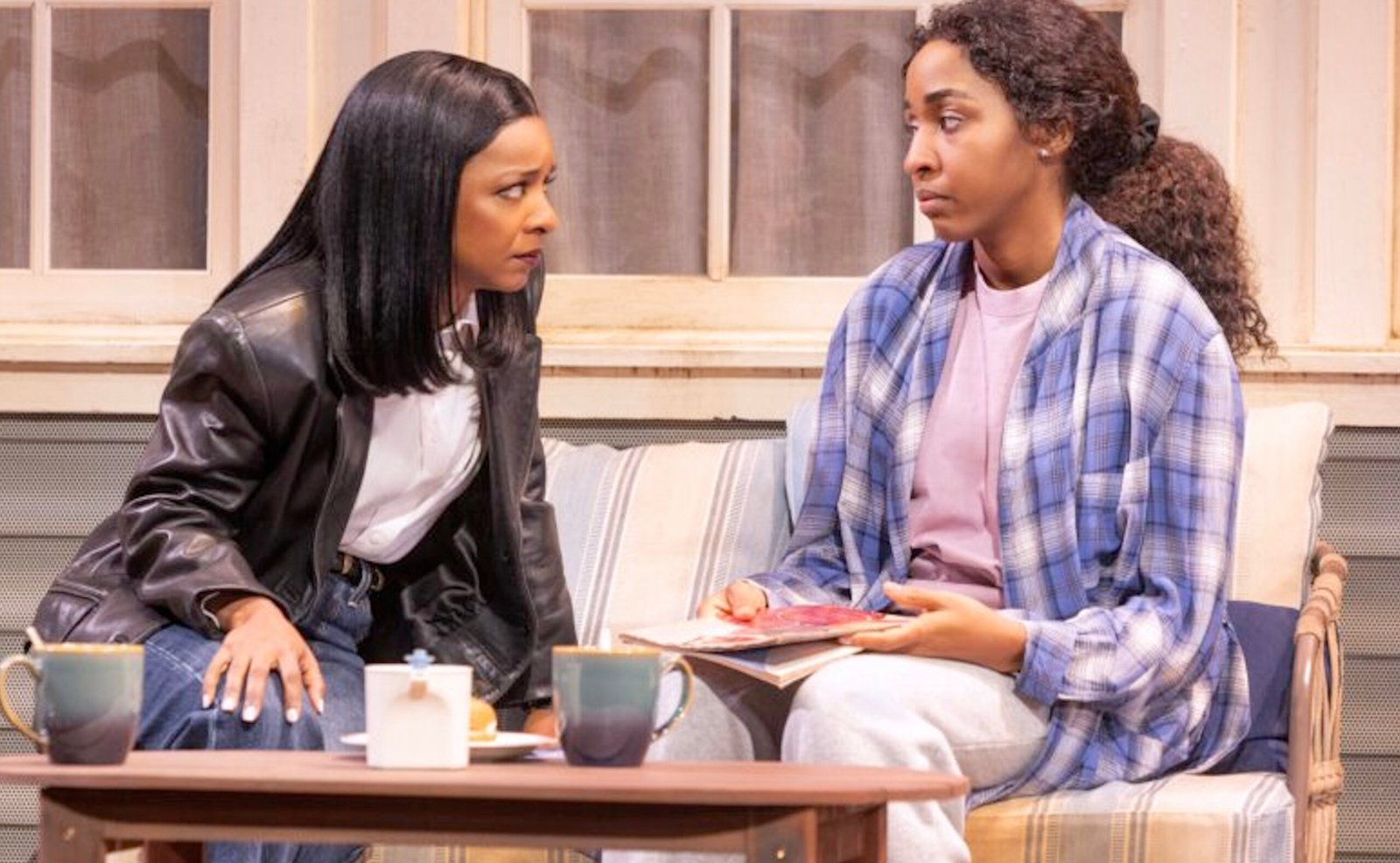
Proof springs the first of its several big surprises on you early, probably five minutes in. I can, I suppose, tell you that it’s about Catherine (Avo Edebiri, the grown daughter of Robert (Don Cheadle), a mathematician who revolutionized the field in his early years. Catherine has inherited some of his gifts and, she fears, some of his problems too; there’s a reason why his mathematical mind began failing him after a time. But there’s Hal (Jin Ha), a grad student of Robert’s, to help Catherine sort out some of Robert’s possibly-promising raw material; and Claire (Kara Young), Catherine’s older sister—a meddler, but not a stupid or insensitive one, who takes it upon herself to help Catherine sort out her life.
If David Auburn’s play sounds merely like a domestic drama in a college town (the town is a suburb of Chicago, by the way), that’s because of the things I can’t tell you: those elements that make it something of a mystery, and in its own canny way, something of a mathematical working-out of the human spirit. I can tell you it is often surprisingly funny, touching when you least expect it to be, an extremely articulate portrait of extremely articulate people, and very convincingly human. The playwright skates a bit here and there on the implication of a great mathematical proof whose sum and substance never quite makes it onstage (not that most of us would understand it, if it did), but he just manages to keep it at bay without making it seem the concocted McGuffin upon which the tale hinges—which, structurally, it is.
I can also tell you the revival is sensitively directed by Thomas Kail and acted as sensitively by all hands. There were moments, not many, where, to my sensibility, I was a little too aware of actors at work—describing when and where would risk spoilers—but for the most part, the quartet of players functions as a well-balanced ensemble.
In this day and age I don’t know if it’s even worth pointing out this kind of obviousness, but when the play debuted, and throughout all its major priductions, unto the film adaptation, all the characters were played by white actors. The cast of this revival features three African-Americans and one Asian-American. I’m always happy to see nontraditional casting applied to classic roles—and I think by now one can safely categorize Proof as a classic, however contemporary—but the particular beauty of Proof is that it requires absolutely nothing in the way of “reimagining” or reinterpreting the characters for cultural verisimilitude. You can present the family or the grad student as any ethnicity you choose and the text is 100% accommodating. And a classic can’t get more American-American than that.