
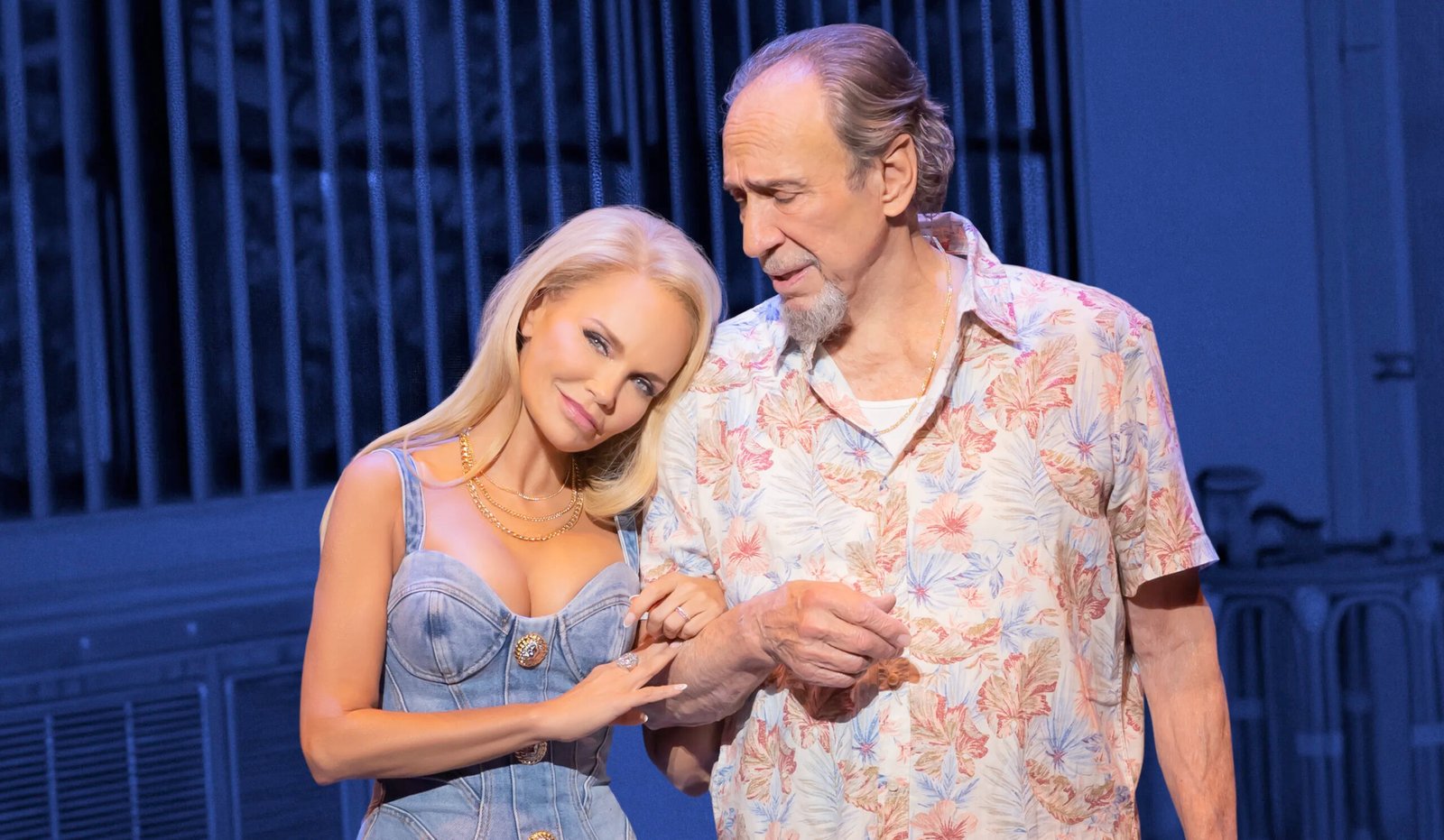
THE QUEEN OF VERSAILLES
Music and Lyrics by Stephen Schwartz
Book by Lindsay Ferrentino
Based on Lauren Greenfield’s documentary film The Queen Of Versailles
and the life stories of Jackie and David Siegel
Directed by Michael Arden
Starring Kristin Chenoweth and F. Murray Abraham
St James Theatre
Official Website
I’m not going to spend too much time exploring production values and performances here, because all those aspects of the new musical Queen of Versailles—set to close, top of January—are just fine. Top grade talents delivering at the top of their game. You can read about them elsewhere.
I just want to spend a little time on something else. Which is the topic of likability.
In brief, the show (which has its roots in a documentary of the same title) tells a version of the true story of Jackie and David “The Timeshare King” Siegal, a billionaire couple who tried to build the largest private home in America, a replica of the French Palace of Versailles, but faced ruin during the 2008 financial crisis. Much has been said about the musical failing to connect because the characters are fundamentally unlikable. That they don’t even have the charm of an ambitious schemer, like Mama Rose or J. Pierpont Finch.
But that’s a false principle. It doesn’t really get at the heart of the problem. Which is subtler.
Likability is a highly overrated quality. Charm needn’t come into play. It helps if some supporting characters have qualities that gain your sympathy, especially as they’re likely to be in conflict with a myopically driven central character; but your main character is the core and the motor.
Nothing much about Sweeney Todd (the character) is charming. He turns from a darkly brooding man bent on an arguably just revenge to a serial killer. His admittedly somewhat charming accomplice, Mrs. Lovett, abets him in disposing of the bodies in meat pies: cannibalism. Yet since the show’s 1979 debut, it has almost never been out of production somewhere. Why?
You don’t have to like your main characters, or even be charmed by them, you just have to enjoy them. And when characters can be enjoyed, you get on their ride because whatever they’re after, and the reason they’re after it, is compelling and suspenseful enough to pay you back for the effort.
The problem with the central characters in Queen of Versailles is that they’re just not folks you want to hang with. They’re transactional, acquisitive, insensitive to the emotional needs of anybody else, what they’re after is the validation of staying where they already are—then the desire to return to where they’ve been, which they do, at cost to their humanity and the existential health of those around them…and when it’s over, they haven’t experienced any meaningful rite-of-passage. You’re not emotionally rewarded, or given a sense of story catharsis, for being in their company.
However…as I said at the beginning, it’s delivered with flair and professionalism, which is why the audience responds with laughter and applause; which is usually not misleading, but in this case, is. They’re compartmentalizing their appreciation for craft and skill and even artistry apart from what the material is saying to them.
That said, treatment is everything; if another team had found a way to address those issues—of reframing the characters to provide them (and us) with a compelling sense of journey toward a satisfying endgame, we might be having a very different discussion. Assuming such reframing were even possible, which is by no means certain. But that reframing would involve adding to and altering elements endemic to the source material—elements that may be fascinating but are nonetheless resistant to effective musicalization. It would involve the age-old tradition—as exemplified in Gypsy, which bills itself as “a musical fable”—of changing the facts; freer adaptation.
But as it stands, composer-lyricist Stephen Schwartz and librettist Lindsay Ferrentino have embraced the source material, built-in traps and all—and that’s why it’s defeating them.
Which leads us to…another flawed Schwartz show, but one that conquered its flaws, in large measure because you do want to hang with the folks. And that show is…(click here for the reveal)