
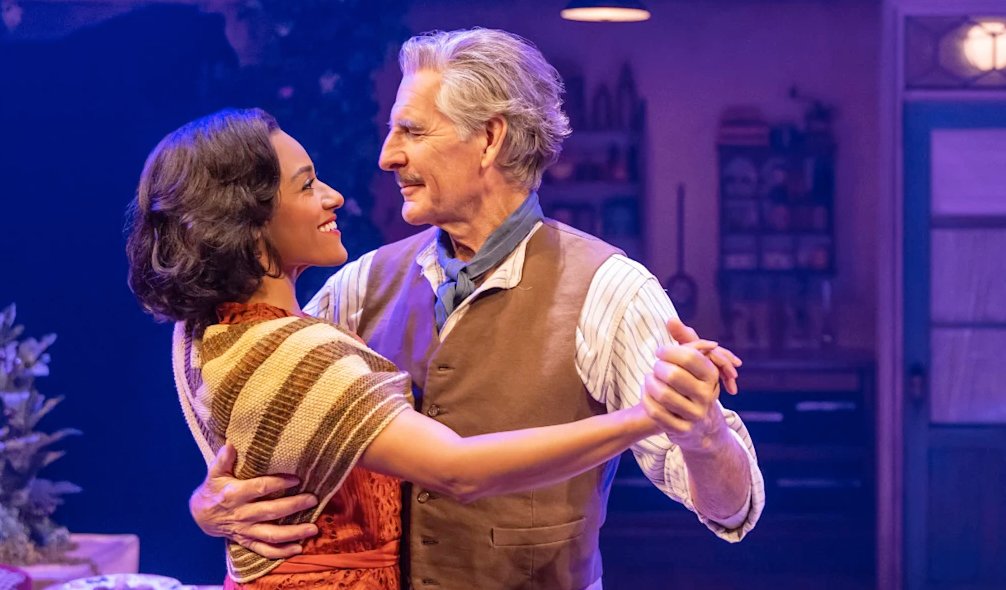
THE BAKER’S WIFE
Music and Lyrics by Stephen Schwartz
Book by Joseph Stein
Based on the film La Femme du Boulanger by Marcel Pagnol
adapted from a vignette in the novel Jean le Bleu by Jean Giono
Starring Scott Bakula and Ariana DeBose
Directed by Gordon Greenberg
Classic Stage Company (CSC’s show website)
Under certain conditions, a musical dramatist can stick with a so-called “failed” musical until it gets its due. “Due” doesn’t necessarily mean commercial success, but it may well mean, at long last, a fair hearing. Nobody who doesn’t actually work in the business of developing musicals can truly appreciate the forces that can work against you, if the stars are not in alignment: the ego collisions on the creative and/or production team, the political crap that obfuscates the artistic goal, the mismanagement that causes anything from time shortage to true chaos that prevents changes to be made with clarity. And it takes relentless and sometimes stupid courage to stick with a show that has sustained major failure, solely on the belief that you know it to be worthwhile, if only the proper adjustments are made and a healthy working environment can be assembled.
The canon of composer-lyricist Stephen Schwartz is perhaps more populated by shows of this nature than any other major writer. Alongside his hits—Godspell, Pippin, The Magic Show, Wicked—are an equally impressive array of shows that have become cult favorites just by dint of the author’s tenacity in refusing to say die: Working (this one an anthology featuring the work of numerous songwriters), Rags (in which he was lyricist to Charles Strouse), Children of Eden and perhaps most famously, his and librettist Joseph Stein’s adaptation of The Baker’s Wife, based on the 1938 film by French director Marcel Pagnol.
The trials and tribulations of the first production have been chronicled elsewhere—Google Peter Filichia’s excellent reduction within a recent interview with Schwartz—but suffice to say that after revolving-door personnel changes, including several directors and both stars, the show closed in Washington, D.C. The stars it wound up with were Paul Sorvino and Patti LuPone, who, along with supporting leads Teri Ralston and Kurt Petersen, preserved 11 songs on a full-orchestra album, the first of the Bruce Yeko produced series of recorded flops on the OC (original cast) label. Though usually produced with major-label expertise and polish, not many of the OC recordings met the promise of delivering first-rate scores from flawed shows…but The Baker’s Wife, released in 1977, became a renegade favorite that has never been out of print since.
The recording begat several other attempts at revisiting the material, including an ill-advised, badly cast, off-Broadway production at the York theatre’s previous uptown home, directed by Schwartz himself, starring Jack Weston; and a full-bore West End production directed by Trevor Nunn, starring Alun Armstrong; and, most crucially, a production that opened in 2005 at the Paper Mill Playhouse—perhaps as close to an ideal rendering of the material as might be hoped for, and clearly the foundation for the smaller scale revival currently at CSC, sharing the same director, Gordon Greenberg.(On one level, it’s the story of Amiable, a middle-aged French baker [Scott Bakula), and Geneviève, the much younger woman (Ariana DuBose), who has married him seemingly because he was kind. But on another level it’s also the story of the desperately baker-less town into which they have moved—who swoon over his baking prowess. And where Geneviève, despite at first resisting, is eventually consumed with passion for Domenic (Kevin William Paul), the young man who pursues her. After she runs off with him, Amiable is so despondent that he can no longer bring himself to work. The town, again breadless, is equally, if differently, despondent. They discuss how they might find the baker’s wife and return her to her husband—at first motivated by their own need. But somehow the crisis galvanizes and unites the previously bickering community. (This is the innovation Trevor Nunn is credited with bringing to the material: dramatizing how a domestic event impacts an entire town, not just the triangle of participants at the center). And so it is not just our leads, but our town who emerge changed at the end. And in the end, of course, Geneviève returns to Amiable, having realized that in a relationship, fire is not necessarily warmth.
The basic problem with the material is there’s no real suspense to it. It’s a triangle that can only resolve one way or there’s no story and less point. So everything, everything, everything hinges on (1) how it’s played; (2) who you cast; (3) style, energy and musicality. The trick is in making us buy into the suspense felt by the characters. We know how everything will turn out, but they don’t, and if a production of The Baker’s Wife can charm us with their perspective, with the details along the way, we’re not then waiting for an obvious story to spiral down to a foregone conclusion. Then, you see, the game becomes a savored anticipation of an inevitable satisfaction.
It’s a delicate balance to maintain, and a slender filament of tension to keep taut, but at CSC, as he did at Paper Mill, director Gordon Greenberg and company manage to do it pretty convincingly. Throughout the evening, the audience gives off that inaudible yet unmistakable “sound” of concentration. Having seen The Baker’s Wife where the bottom drops out and concentration with it, I can tell you this: it can’t have been easy to do. Fun, I suspect. But not easy.
Unlike Paper Mill, I have mixed feelings about the leads this time around. Scott Bakula, as always, has a wonderful musical theatre leading man presence…which poses a little problem. He is also, as always, a handsome galoot. He’s not in the same category of character men I’ve seen and heard (on cast albums) in the role: Paul Sorvino, Jack Weston, Alun Armstrong, Lenny Wolpe. Though absolutely, equally gifted and giving his best shot to the truth of the role…he’s a harder sell as a man in danger of losing his pretty young wife. But because he’s so honest an actor, you can make a pact with the illusion. I personally had a much harder time with Ms. Dubose. She does a lot of grand-gesture money-note-moment performing that makes it very hard to locate the character’s inner life. I kept trying, and failing, to track a moment-to-moment reality that felt truly connected. As to Mr. Paul’s Dominic—it’s a very decent young-stud turn…but he has a tricky role. In the earliest iteration of the musical, Dominic was more of a mercenary rakehell pursuing his latest,est new fixation. But of course, Dominic having that pathology makes Geneviève’s infatuation harder to tolerate with any sympathy. So Dominic is now more of a callow young man whose background with women is left undefined and who may in fact have fallen genuinely in love; but he’s still the aggressor who would knowingly, brazenly seduce and run off with another man’s wife. So while he’s not evil, he’s the villain…? So it’s left to Bakula, and the ensemble playing the villagers, to supply ballast and create an ambiance—a distraction, if you will—that keeps you from scrutinizing how slender and inevitable the primary story truly is.
And fortunately they do. For reasons I can’t quite articulate, the villagers’ mini-dramas seem collectively more padded in this iteration of the show than when Mr. Greenberg directed it at Paper Mill—but this is a very different physical production with a very different cast (save for Kevin Del Aguila, who returned as Antoine, the town drunk, and has since been succeeded by Steve Rosen), so it may simply be due to something inchoately alchemical. But it also isn’t fatal. Led by Judy Kuhn as the café owner, Denise, who croons the opening “Chanson” and occasionally breaks the fourth wall, they each deliver memorable characters with brushstrokes that manage to be bold yet rarely caricatured. In the hands of Arnie Burton, Alma Cuervo, Robert Cuccioli, Nathan Lee Graham, Sally Murphy, Manu Naryan, Will Roland, Mr.Rosen, Hailey Thomas, Samantha Gershman and Savannah Lee Birdsong, humanism usually prevails.
All production elements add to the delicate illusion: sets (Jason Sherwood), lighting (Bradley King), costumes (Catherine Zuber), musical direction (Charle Alterman), and choreography (Stephanie Klemons).
Think of The Baker’s Wife—to offer an obvious but apt metaphor—as a soufflé: based on the team’s mastery of the kitchen, it can rise or fall. For the second time, director Gordon Greenberg has delivered it at its fluffy best, or as near to that as the Eastern theatrical community has seen in a major venue. It may still be too fragile for Broadway (although the thrust stage production would be very at home at Circle in the Square) because the show is the show and the trick of it is the trick of it. But such a move would make for the kind of triumph that warms the heart of any musical dramatist who can legitimately say, if only we’d done it this way the first time. And having been there myself, I can tell you for sure: that’s where the warmth is…