
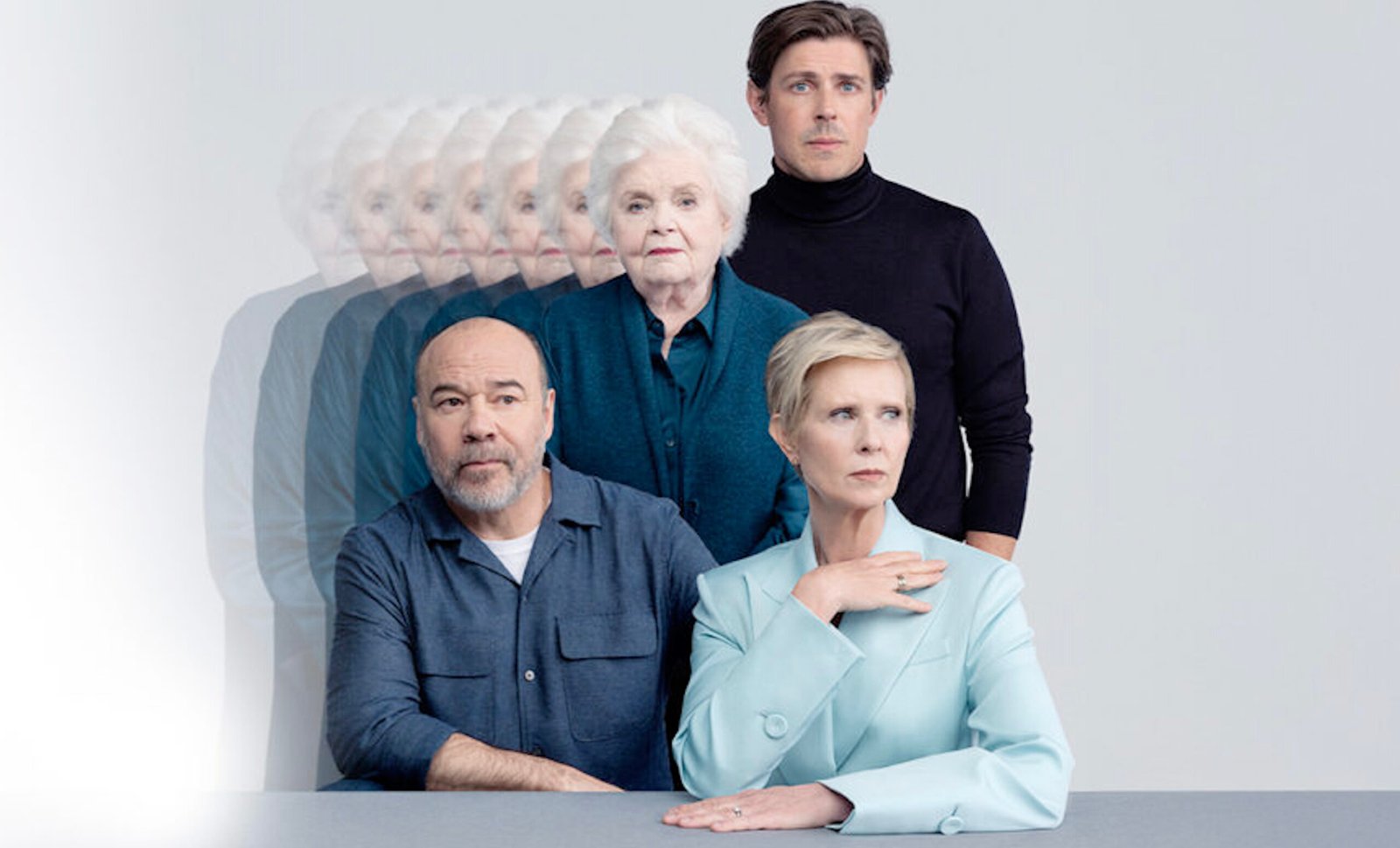
MARJORIE PRIME
by Jordan Harrison
Directed by Anne Kaufman
With Danny Burstein, Christopher Lowell, Cynthia Nixon, June Squibb
A Production of 2nd Stage (Play Website)
Helen Hayes Theatre
The Broadway revival of Jordan Harrison’s 2014 play, Marjorie Prime presents a very decent narrative positing what may be an aspect of life in the not-so-distant future. But it made me imagine that those who might find it bracingly thought-provoking are either unfamiliar with science fiction tropes that go back to Isaac Asimov’s stories of robotics and artificial intelligence—that he began writing in 1940—or need their familiarity with tropes of The Twilight Zone refreshed. For the only thing missing from the evening is Rod Serling to do the intro and outro.
Honoring the classic Zone philosophy of stories about ordinary people in extraordinary circumstances, it represents one of the quieter, more contemplative episodes in its science fiction roster. There are no supernatural horrors, there’s not even that much in the way of plotting, though there is definitely a story, which is to say a plan of progression. Despite the play’s production history, and the subsequent, well-regarded feature film, I’m still loath to reveal anything at all (one too many details can spoil the whole evening); so suffice it to say that Marjorie Prime is something of a family drama, because when it begins, one member of the family is conspicuously artificial—but just as conspicuously of fluid intelligence: able to learn, extrapolate and adjust on a nuanced level. And I think I’ll leave it there.
The play takes place on a set (Lee Jellinek) that represents a section of the family house: a living room area with exits out and to the bedrooms, set off from a slightly raised kitchen area. The dramatized timeline is several years, but succeeding scenes don’t do as much narrative heavy lifting as you might think; once you understand the narrative game, you make large intuitive leaps—as intended.
As befits such an enterprise, a delicate balance of elements is maintained. All the primary practitioners are in the header above and all are finely attuned to the tone and the endgame. As well as to the storytelling traditions and genre tropes. Which, in the context, is not insignificant.
That’s all you can ask.