
BEACHES: The Musical
Book by Iris Rainer Dart & Thom Thomas
Music by Mike Stoller
Lyrics by Iris Rainer Dart
Based on the Beaches novels by Ms Dart
Directed by Lonny Price and Matt Cowart
Majestic Theatre
Official Website
Reviewed by David Spencer
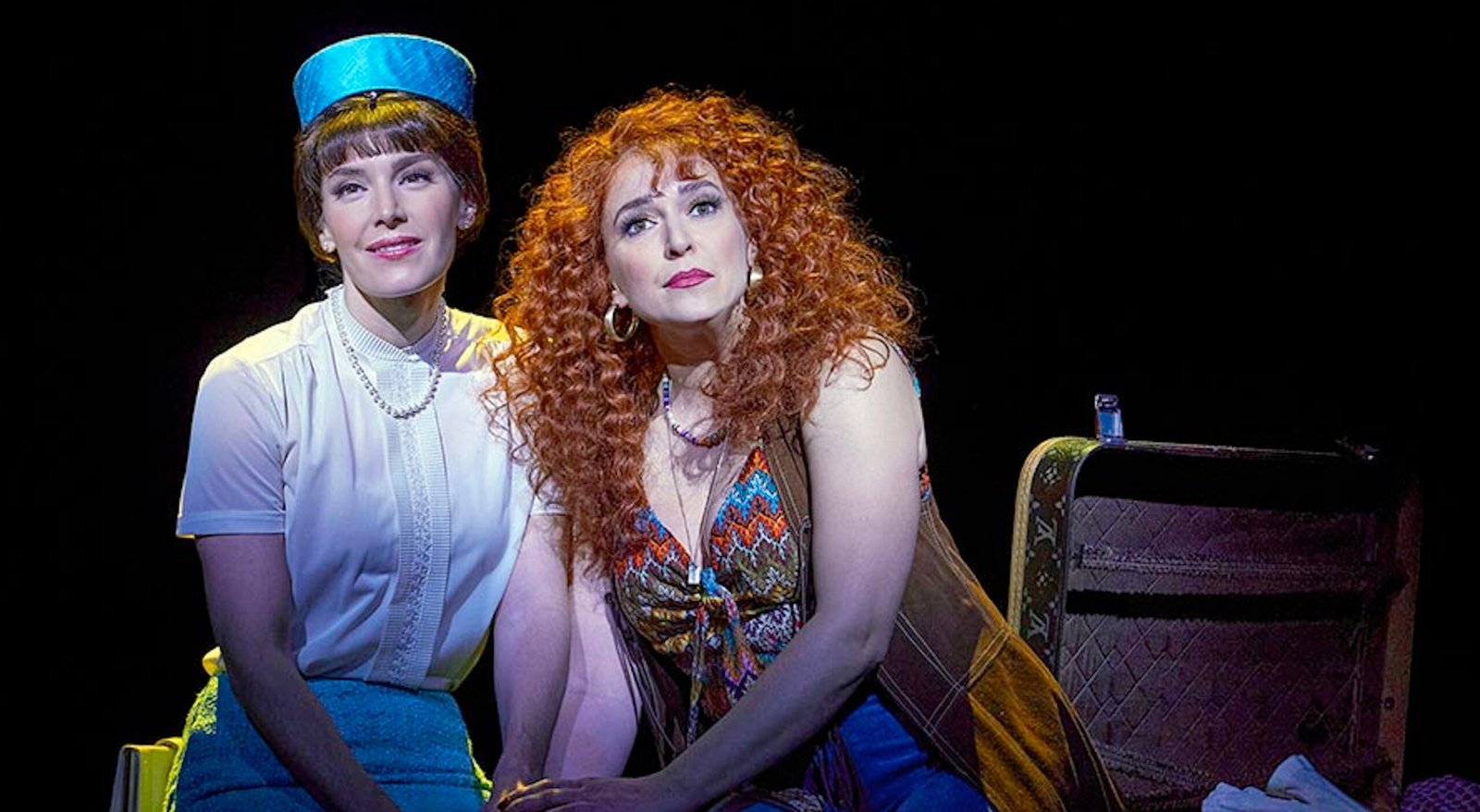
Beaches is a musical based on a highly popular chick-lit novel and the even more popular chick-flick it begat (both written by Iris Rainer Dart), and despite its troubled production history, its problems seem to be baked into the premise. That premise—in the libretto also by Ms Dart (taking over from the late Thom Thomas)being the lifelong friendship, starting in childhood, between two women: an extroverted aspiring (and eventually successful) actress-entertainer (Jessica Volk), and a more white-collar conventional attorney (Kelli Bsrrett). It begins when the actress, upon receiving some news, suddenly leaves the set of her high-rated variety TV show, which frames a flashback.
I watched the musical knowing neither the novel nor the film, but since the only plausible reason for her to do such a thing would involve the health of her friend, there wasn’t any suspense in waiting for the flashback to catch up to the present and reveal that indeed, the attorney is dying of cancer. This is an immediate red flag, because it telegraphs more than just a predictable trajectory. It tells us that the tale will be episodic—impossible for a musical to pull off unless there’s an over-arching goal to be achieved—because musicals require not just story event, but a motoring through-line of plot, and if not plot per se, omnipresent issues needing resolution and decision, to provide tension.(he literature’s very few successful exceptions are sui generis—Beaches doesn’t qualify as one of those exceptions. It aspires, and aggressively so, to make its mark in the classic-conventional arena.)
There are many reasons for this, but among the most important is that without that thread working its way through the score, providing opportunities for songs about objectives, or that cover narrative ground, there’s not that much to sing about except states of being: I’m glad we’re friends; I’m sad you’ve disappointed me; I miss you; Yay, we’re back together. Even the men in their lives (the only supporting characters with the emotional weight to sing as well) are this limited: You’re a helluva woman; You don’t need me and I need my own space. And the problem there is, since there’s nothing going on except developing and sometimes maturing relationships, the ground the songs will cover has already been established in the dialogue leading up to them. Even if you can argue that the songs are a continuation, taking the emotion to its ultimate expression, you can’t make a case for any of them being surprising. Which creates a feeling of Beaches dutifully just, well, going through the numbers.
Exacerbating this is the feel of the score itself. Full marks to Ms Dart, also the lyricist, and composer Milke Stoller (he of Lieber and…) for being meticulously craftsmanlike, but they’re both old timers, visiting the world of musical theatre, not permanent, steady occupants, and so their sensibility hasn’t had the chance to become richer with the decades; the score simply sounds like something from a mid-level show written in 1965. There’s a difference between reflecting an era and being anchored to it. Beaches seems unaware of the distinction.
This is further made manifest in the direction and staging (Lonny Price and Matt Cowart) which is very cornball and old school, as you might have found in the old variety TV shows (of which Ms Dart is a veteran) or one of those videotaped musical episodes of The Honeymooners. My companion of the afternoon pointed out the performances of our heroines as children. They’re cute kids, but they might as well be playing Baby June and Louise. There’s nothing naturalistic about the conventional friend (Zeya Grace) and there’s no clue that the actress (Samantha Schwartz) has anything like superstar juice in her future.
Not to mention that the musical ends three times, carrying on fifteen minutes beyond what feels like its natural closing bookend image, showing us nothing we need to see, telling us nothing that isn’t already implicit. But using all that to give the actress character an excuse to sing the film’s iconic song, “Wind Beneath My Wings”, not written by Dart and Stoller (written in fact by Jeff Sibar and Larry Henley), which comes off as yet one last shopworn obligation being fulfilled.
All that said, I actually don’t mean to be relentlessly hard on the creative team. Yes, it’s very possible that a younger, hipper group adapting the same material might have made it seem fresher. But the “it” of it remains the rub. Beaches is a prime, perhaps iconic, example of a difficult truth: Just because a property can provide organic motivations for individual song moments, and characters who may have passion enough to sing deservedly, doesn’t necessarily mean that, on aggregate, can support the architecture of a full musical.