
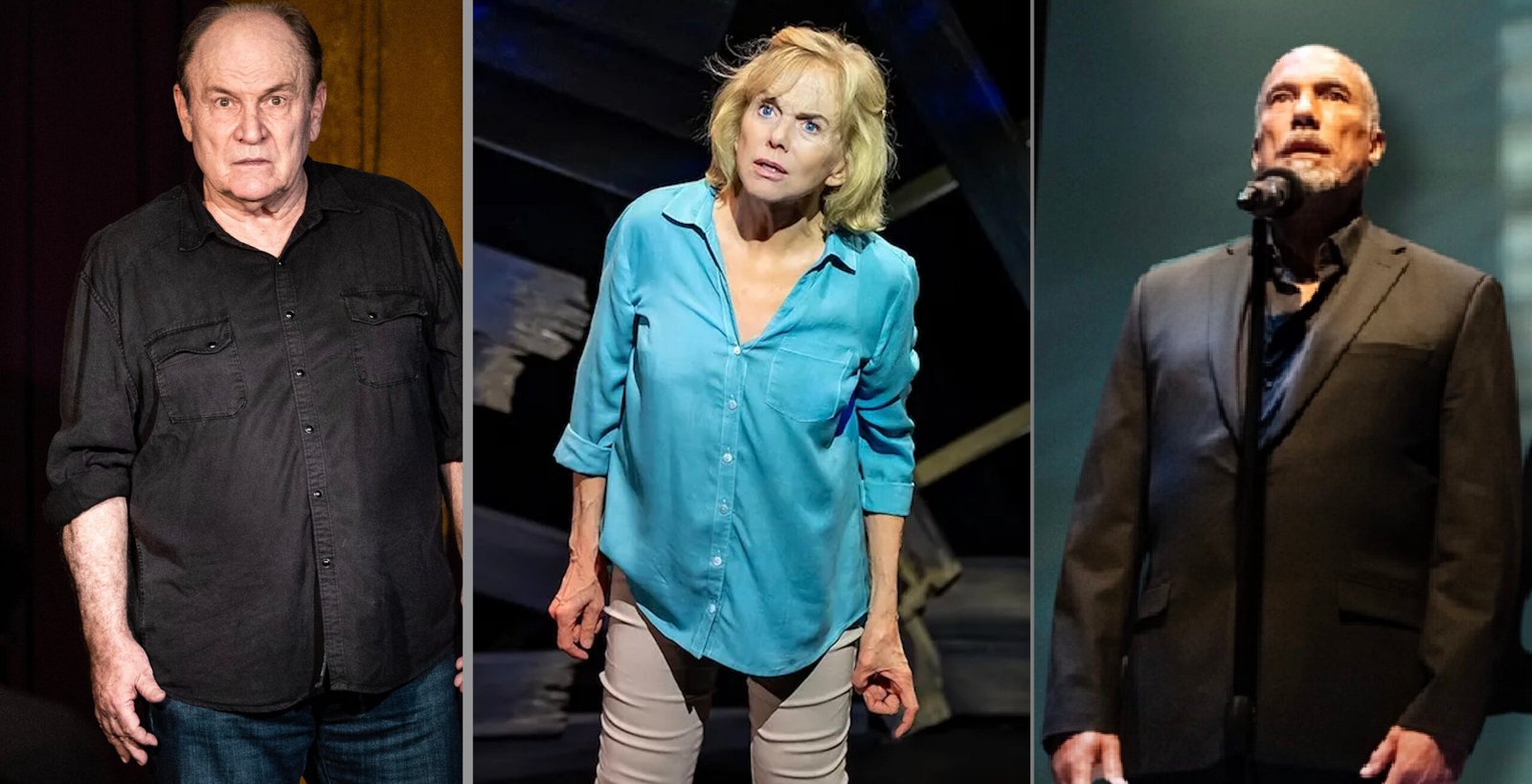
3 First-Person Confessionals: A Round-Up
LOST IN DEL VALLE
Performed and Written by Ned Van Zandt
Directed by Amir Arison
Soho Playhouse
•
CRAZY MAMA
By Sharon Scott Williams
Directed by Anson Williams
Starring Linda Purl
59E59
•
IN HONOR OF JEAN-MICHEL BASQUIAT
Created and performed by Roger Guenveur Smith
New York Theatre Workshop
Reviewed by David Spencer
I think I’m obligated to be cautious here, because for all three of these shows, which I saw, by total coincidence, three days in a row, the audiences seemed to be a lot more with them than I was. As to why that should be: All three—monologues, accompanied by a fellow performer off to the side, providing musical and/or sound effect mood setting, commentary and interjection—are personal confessionals, and cracking open one’s soul for such an event takes a significant degree of courage. If the performer is sufficiently able to hold attention and unequivocally authentic, audiences are inclined to be sympathetic/empatheyic. As to why that should be: basically you’re presented with someone implicitly saying, I’m going to trust you with this deeply personal journey of mine. And one way or another, audiences will connect with an odyssey of discovery leading to new self-realization. Because most of us have been through our own.
As to why I was less taken with these shows than the audiences around me: I’m too old, I’ve seen too much, and as soon as each started, I knew what I was in for. I don’t mean to say I understood the ground rules of style and presentation; ideally, one should know that. No, I mean could see the coming trajectory, the destination. As common for a real-life confessional, each narrative, though existing under a cohesive thematic arc, was episodic, sometimes fragmentary, occasionally ruminative-discursive-philosophical…and try though I might to concentrate on the ride, I was never surprised…and failing to experience much story tension, at each one, I checked out, somewhere between the mid- and the two-thirds point.
Yet I write this—what would you call it—highly subjective survey, not because I believe it to represent a consensus—I don’t—but because I wasn’t alone. This essay is somewhat more about personal sensibility than objective worth. If your sensibility resonates with mine, you can safely give these a pass. If not, then by all means attend.
Lost in Del Valle is the story of, and told by, Ned Van Zandt. You’d likely recognize him if you don’t know the name; one of those middle-aged, slightly weathered character actors who seem to have stepped out of some random walk of life and just be, natural as you please. Technically, professionally, what they do is acting, but you never catch them at it. Van Zandt, a native Texan, and a homosexual without any of the characteristic tells to ping attuned gaydar and thus affect his utilitarian casting, he had a decent career as a younger man, but then fell in with the wrong crowd (chant it: sex, drugs, rock and roll), began using heroin and cocaine, commensurately effed up his life and wound up in a Texas prison: Del Valle.
What you may dig: Van Zandt has an effortless delivery, which includes being able to switch characters and voices with economic efficiency. He’s as natural an autobiographical storyteller as he is an actor. Van Zandt’s anecdotes matter-of-factly include a few celebrities, which adds some low-key spice. Because he’s personable, and has a self-effacing sense of irony, that may be enough to have you alertly rooting for him.
Why you might feel as I did: Didn’t care. I enjoyed Van Zandt as a presence, but his true prison experiences aren’t substantially different than the fact-dramatized or invented dynamics you’ve seen in any number of prison-set films or episodes. There’s the raging prisoner of granite and anger, boss of the ward, whose protection is needed; there’s the gibbering crazy guy who shares the gossip about what’s going down; there’s the benign guard…you can continue the list of tropes yourself. As for the rest of the story: Basically he got himself in trouble. Then figured out he had to quit drugs. Did. His comeback is this show. Shrug emoji.
Crazy Mama is actually a confessional once removed. The script, by Sharon Scott Williams is adapted from her memoir about growing up in the Deep South as the child of a mentally disturbed mother; and though the term is not used specifically, mama’s malady seems to be severe manic-depression. Under the direction of the playwright’s husband, Anson Williams (yes, the former Happy Days sitcom actor), her storytelling proxy is actress Linda Purl.
What you may dig: It’s a tale of emotional vulnerability, and a narrator in that context likely doesn’t get more sympathetic than a young child, even as portrayed by a mature woman. Crazy Mama‘s anecdotal verisimilitude may provide enough fascination to draw you in. There aren’t many who—via similar personal experience and/or knowing someone who’s had such experience—won’t find an entry point for identification.
Why you might feel as I did: Here I can give a bit of critical appraisal divorced from my subject matter sensibility. I’ve long been a fan of Ms. Purl; even as a senior citizen, she’s still spry, energetic and pretty, very able to hold attention. But she’s either been directed to, encouraged to or enabled in physical over-gesturing and invisible object-place indicating. There’s a lot of leaning and reaching and pointing at harrowing things ahead, or glancing back at harrowing things just behind. Ms Purl doesn’t, per se, over-act or indulge emotiveness…but the constant illustrative push makes one very aware of an actress at work…and at that, at work to make a narrative without much movement—only incident—seem dynamic.
As to the script itself: There’s too much about the daughter’s impressions, and the effect mama has on the family, and not nearly enoughthat features mama herself. I can, however, easily get down with the argument that a little of a character in the grip of madness goes a long way—indeed, how many plays and movies have we seen in which an extreme character who only gets a few minutes of stage or screen time becomes iconic, if not steals the show outright—but in that case, every minute spent with mama needs to count; and mama’s madness seems case-history generic. Perhaps it can’t be anything else, but never meet her before madness sets in, so we have nothing “pure” to provide contrast; and comes a point at the end when we finally do get a glimpse of her freed of mental demons…she’s just as generically a loving mom.
And the whole is two acts with an intermission, which is way too long.
Finally, there’s In Honor of Jean-Michel Basquat, actor-playwright-director Roger Guenveur Smith’s reminiscence about his friendship and collaboration with the Neo-expressionist artist whose graffiti and street art made him a sensation in the art world, a the youngest person ever to have exhibits in places like Documenta in Germany and the Whitney Museum in New York. And who died of a heroin overdose at 27.
What you may dig: Though the bulk of Basquiat’s career happened in the ‘80s, there’s something very ‘60s beat poet about Smith’s telling. It’s not conventionally, linearly anecdotal; it’s more a series of situational snapshots and brushstrokes, as abstract and impressionistic as Basquiat’s art itself. Occupying a tight, square spotlight for the entirety of the hour. Smith stands bare footed, wearing a suit with open necked shirt, his basso-voice and (one suspects) toned torso grooving quietly with the moods and transitions; he’s as immersed as his delivery is immersive. You may appreciate the spell he weaves.
Why you may feel as I did: For the exact same reasons some may dig it. In Honor of… is a downtown show, a quintessentially downtown show in the classic mode. In certain particulars, it’s unique. In the grand scheme of underground culture, it’s a direct descendant of beatnik reciting poetry to the accompaniment of a bongo drum. My companion of the afternoon felt precisely the same.
But as I say, there was reason to believe that a majority of the audience—just as with the other two shows—was in sympathy. I can’t be the categorical authority on any of them. And I hope I’ve made them attractive enough to those who might be in the pro camp. All I can do is prepare you to make your choices.
Go forth and make ‘em.