
THE WHOOPI MONOLGUES
Written by Whoopi Goldberg
Directed by Whitney White
A Production of Lincoln Center Theatre
at Lincoln Center’s Mitzi Newhouse Theatre
LCT Website Show Page
Reviewed by David Spencer
It’s odd what memory retains fully, what it purges completely and what artifact crumbs it stores as placeholders. Until I started writing this review, I was sure I’d never seen Whoopi Goldberg’s one woman show in its original iteration nor its 20th anniversary revival; nor the TV special; nor heard the original bestselling album the first engagement generated. That I had approached The Whoopi Monologues, currently at Lincoln Center’s Mitzi Newhouse Theatre lily white-guy pure. That all I knew for sure was that in the original show, she had played a number of characters of her own invention, in what was essentially an anthology of monologue plays she’d written to tell their stories…and that this time, the six surviving monologues would be distributed among as many actors.
I got curious about the seventh. I researched it. It was about a handicapped woman, whose disabilities made her socially quite awkward; I read that it was deemed too hot to handle, in this age where it’s easy to trigger a hue and cry if a similarly handicapped actress isn’t playing the part. I also read that this monologue had closed the evening, and that told me there was no way it would end on a dark or sadly ironic note; Whoopi, functioning not only as a versatile actress-writer, but a seasoned stand-up comedienne giving a concert, would end an evening of solo portraits on a high. The cutting of the monologue didn’t quite make sense to me, but I figured I find it on YouTube, and sure enough.
Four things struck me: (1) That it was too bad the monologue was cut. It tells a sweet story about self-reliance and finding true love with a non-handicapped man. (2) That the decision to cut it probably hadn’t been easy, and might have been over-cautious. But I got it: the woman candidly refers to herself as a cripple…and has a moment where she fantasizes her own normality, and in so doing, physicalizes the fantasy; it would have required an actress without handicap, because for that brief minute or two she unkinks her body and voice and becomes grateful. (3) That I knew the story beats. Not all of them, but enough to anticipate—not predict, as in, I can tell what’s coming, but anticipate—the trajectory. And upon that realization came…(4) That I’d actually had similar flashes of familiarity during several of the new production’s monologues, just not altogether consciously. Conscious awareness came with seeing the original author-performer deliver the same material. Clearly for the second time.
This may say something about the evening.
For a single actress/author, the collection of portraits is a chameleonic tour de force. For five actresses in what is essentially a 30th Anniversary revival…it’s a bit more of a protégé showcase, with each actress more closely embodying her role when not simply cast to type.
On the one hand and arguably: The latter is less interesting. I believe of many plays and musicals that they possess what I call “organic integrity”: something about their original energy, intent and sensibility that peeks through, even in a revival that would seek to alter that quality, or that is generationally, or via other causes (there are many, including plain tone-deafness), unconnected to it. My trick of memory tells me that the origins of the evening as a showcase for a single actress aren’t just academically apparent and historically known, but inextricably woven into its DNA. (As a sidebar, I should add, the friend who attended with me is one of those folks whose familiarity with cultural history is modest, and didn’t know anything much about the show before seeing it. She told me after that she found the character sketches occasionally surprising in terms of the storytelling, but mostly thin. When I told her that it the material had been a showcase for the author, she responded: “That makes more sense. I wish they’d done it that way.”
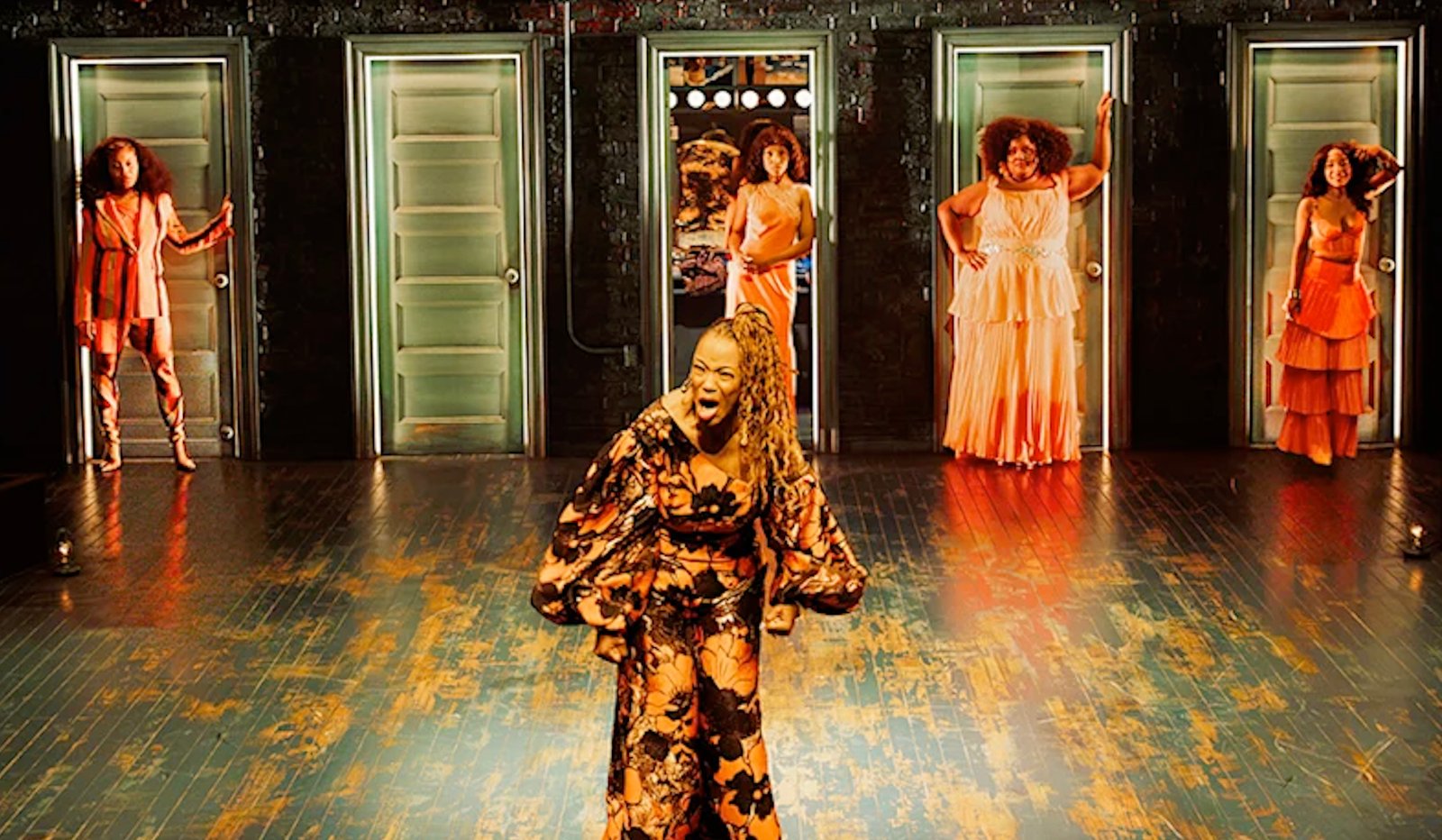
On the other hand, and this is the argument: The material is inextricably bound to Whoopi Goldberg’s imprimatur as a media personality, actress and performer. Even if you’ve never seen her do these particular bits, they radiate her sensibility, the mark of her style. And to many, they’re recognizable, like favorite songs, or the set pieces from Monty Python and the Holy Grail that allowed Spamalot, the musical based on it, to transcend its original cast, so long as it was understood that the material wasn’t being reinvented, just borrowed for a little reimagining. In its way, The Whoopi Monologues is in the same class. It’s perhaps best appreciated by aficionados, rather than newbies. To be sure, newbies can absolutely get on board without previous grounding—it’s nowhere near as “inside” as Spamalot—but from detectable anticipatory audience reaction, aficionados were in force. The actresses—Dominique Fishback, Kecia Lewis, Danielle Pinnock, Kerry Washington and Kara Young—all give lovely, committed homage performances, under the direction of director Whitney White, who has also created enough mood-setting and transitional interplay choreography to keep the presentation from seeming too much like a monologue conveyor belt.
Verdict? Well, the general audience level of enthusiasm is palpable. Personal enthusiasm? Mileage may vary. Somewhat, per the above. But given what the enterprise is and means to be, you couldn’t ask (or expect) more of it. So I’d count The Whoopi Monologues as a happy-enough Summer win.