
THE ROCKY HORROR SHOW (2026 Revival)
Book, Music and Lyrics by Richard O’Brien
Directed by Sam Pinkleton
Studio 54
Official Website
Reviewed by David Spencer
I’m too old and I’ve seen too many trends and developments in popular culture to say anything quite as untethered as, “I’ll never understand the appeal of The Rocky Horror Show,” because I do…a rock musical conflation of sex-farce and Z-grade horror/slash/sci-fi movies, with heavy goth overtones; what’s not to understand?…I’ve personally always found it to be…well, how do I put this…lacking genuine wit in its wordplay (I mean, yeah, puns and double entendres, allathat, but fairly pedestrian)…and arbitrary in its storytelling (as if, rather than spooling out a considered plot, the game is: hey, did you think that was crazy? Watch THIS!). Then again, Ed Wood movies and Mystery Science Theatre occupy the same landscape. There’s udeniably a visceral fascination with schlock, particularly if it invites you to laugh with it and at it. And Rocky Horror‘s stunning international success—a half century’s worth!—is an inarguable fact of theatrical history. So, as with a few other sui generis “force of nature” shows, whose appeal resides in an alchemical, lightning-in-a-bottle Zeitgeist tap that both represents and survives its era, I’ve long since made peace with it.
Up to a point.
That point being where a revival of The Rocky Horror Show misses the balance, and it’s more delicate than it might appear, between excess and the illusion of excess. The first being the material’s native nuttiness; the second being the carefully curated delineation of that nuttiness: the invisible restraints and guideposts that give it pace, momentum and valleys-and-peaks rhythm toward catharsis.
At least that was my thought after seeing the current Roundabout Theatre revival at Studio 54. About one third of the way into Sam Pinkleton’s production, I felt it spiraling out of control and starting to become incoherent—so to make sure I wasn’t just applying conventional standards to a show that pretends not to have them, I followed the experience by rewatching extended clips from the film version (The Rocky Horror Picture Show, 1975) and the televised UK tour version (The Rocky Horror Show Live, 2015). Each one had its own ambiance, but both were unambiguous about what they were putting across. Film director Jim Sharman made use of his design budget ($1.4 million, the equivalent of $9-10 million in 2026) to elevate the opulence around the decadence, and his cameras to track the narrative thread; and stage director Christopher Luscombe favored precise scenic, costume and choreographic imagery, keeping his characters as well outlined as those on a Hanna-Barbera model sheet; and as definitively voiced as a Flintstones recording session. For example: when his Frank-N-Futer (David Bedelia), sings “Sweet Transvestite”, you not only understand every lyric, but the import of every line (as opposed to the way it’s often sung, where the actor leans so deeply into rock drawling as to be incoherent without subtitles); and in this kind of show, where madness escalates almost via stream of consciousness, every bit of clarity motors you forward. Bedelia achieves that clarity not only via enunciation…but because he’s smart enough to know that the character’s outrageousness speaks for itself simply by appearing; he doesn’t have to start off at his “top”…he gives himself somewhere to go.
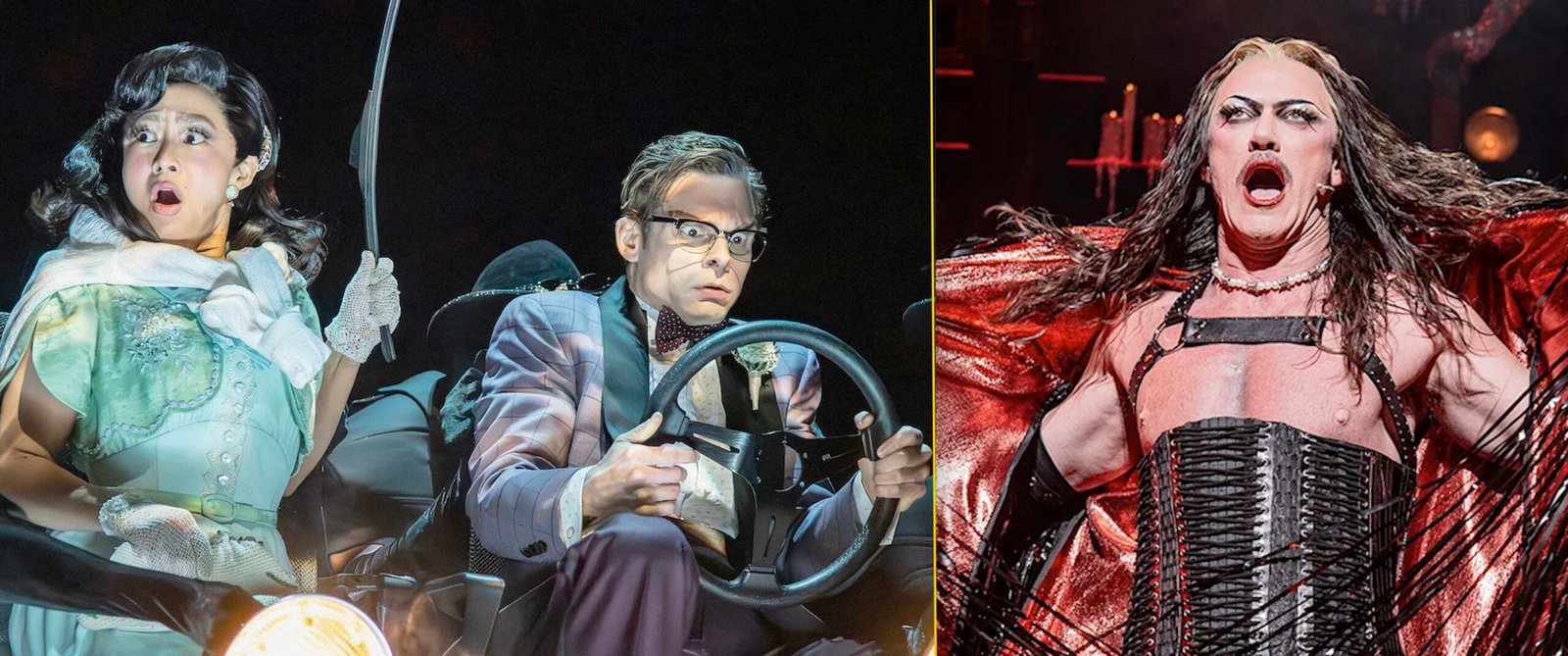
Not so much Luke Evans. As if a pencil-mustached Errol Flynn had donned a long black wig, fishnet drag and high heels, he enters in full strut and roar, at which point, his performance has no secrets left. In various ways, this kind of shoot-the-wad approach is emulated across the board. The characterizations seem more laboriously attitudinal than exaggerated via authentic core connection—even craziness requires its own brand of verisimilitude—such that, rather than being swept along with the illusion, I was constantly aware of actors at work trying to put it across—and that makes an already organically noisy show seem assaultive.
Additionally, irrespective of the actual design budget, the revival looks cheap. I don’t mean purposefully cheesy—a campy environment is built into its premise. Indeed, Rocky Horror may be best with a design that seems gaudily improvised. No, I mean budget-starved. Like someone made off with the extra corrugated cardboard. And returned it. Used.
The night I attended, the audience seemed dutifully engaged, as would tend to be the case—with the Rocky Horror veterans who are likely the core audience. There’s a long tradition of socially acceptable, utterly permissible call-and-response attached to this show; in that way, too, it’s like nothing else. But I got a feeling that even their well-stoked enthusiasm was comparatively restrained. As if they recognized all the familiar elements but weren’t quite digging the delivery system as well as they expected. Perhaps your mileage may vary.
But as far as I’m concerned, at these prices, even schlock needs a meister.