
DIRTY BOOKS
Created and Directed by Mara Lieberman
A Production of Bated Breath Theatre Company
Venue location: 39 W 14th Street #301
Play Website
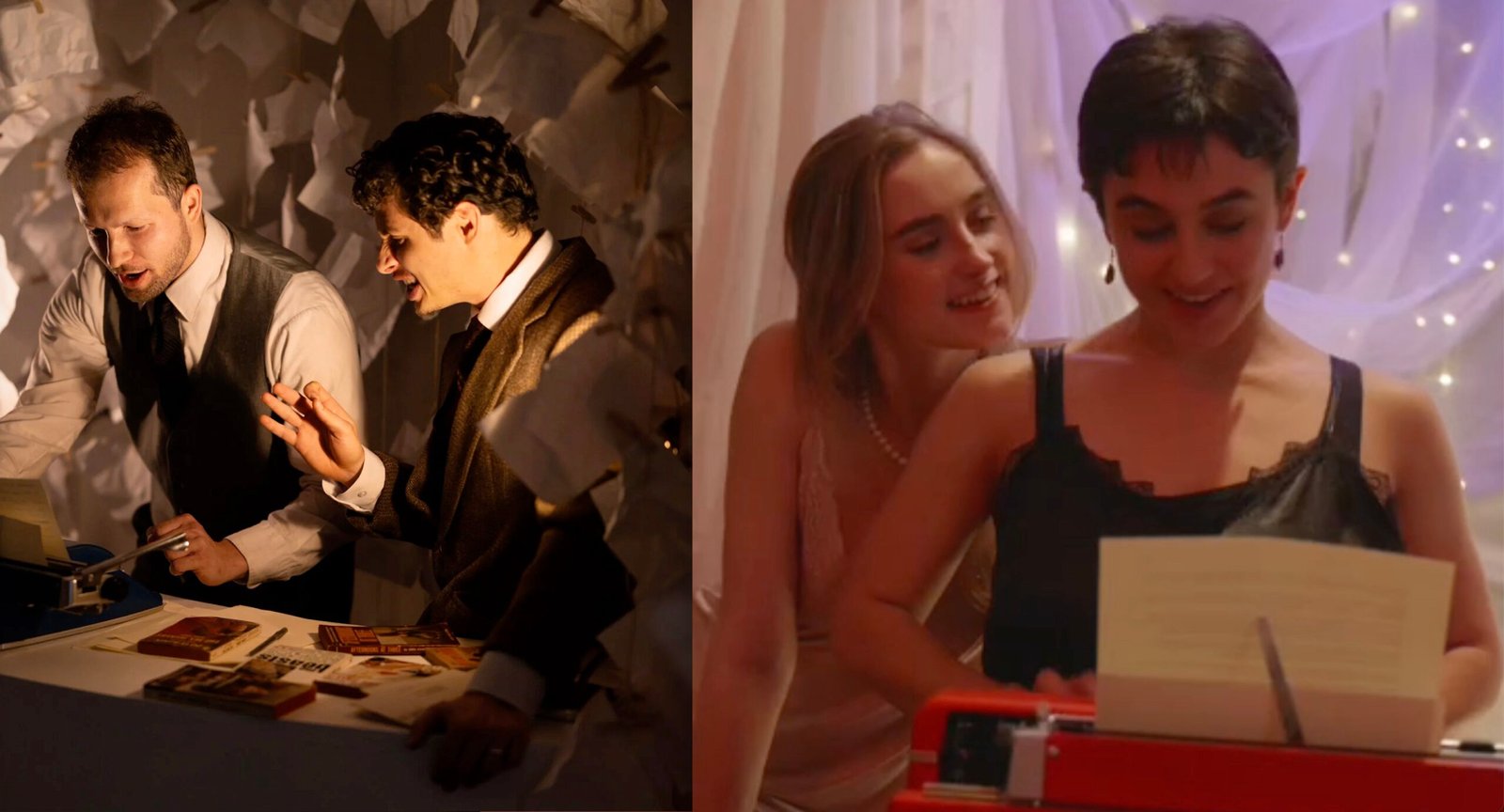
It takes place on the third floor of a commercial office building, in a loft space that has the ambience of a repurposed living room in a shotgun apartment. The walls are white and from the ceiling are many cords with attached notes, seeming to festoon the walls, with clothing pins for more notes. In the center, a “forbidden” space concealed by double doors. Entrances and exits are made extreme left and extreme right. The audience sits along the opposite wall in two rows. Higher chairs along the back, lower seats, some camouflaging lids to hidden compartments, make up the front row. If you attend, the price you pay, over and above what you shell out for your ticket price of choice, is bracing yourself for mandatory complicity: when the flashlight beam hits you, you’ll be required asked to fill in a designated blank—a suggestive title perhaps. And oh yes, before you enter, you have to sign a waiver, allowing your participation to be available for further use. Welcome to Dirty Books.
The somewhat immersive, interactive play—or perhaps theatrical experience is a more exacting description—by author-director Mara Lieberman of Bated Breath purports to be an insider dramatization of the ‘60s sleaze (soft core paperback) phenomenon; but it isn’t quite that. For sure, Dirty Books has its relevant virtues, which are not insignificant, and I’ll get to those; but fulfilling expectations as a creative-liberties primer on the subject…well, that’s arguable. Very. But whether you feel that may depend upon how much you know going in; and I’ll get back to that too.
The main contradiction, in terms of actual history, is caused by conflation of topics, which confuses the issue at hand. Ms. Friedman starts with a little precis, delivered by an uptight display curator (Sophia Carlin), about the history of early 20th century literary censorship in the United States, referencing books which later, ironically, became classics. Okay, social mores. Got it.
Then, as other cast members are introduced in various subversive contexts, the curator switches, pretty much without segue, into an altogether new topic: the ten rules which once governed the content of published literature; rules to prevent racy content from violating obscenity laws; rules hearkening to what language a book could and could not contain, what activities a book could and could not depict, except perhaps by implication. And etc. Okay, so now we know that sleaze, especially, was a form of literature that existed on the edge of era-specific legality. Got that too
Here’s the confusion: There’s certainly a place where the history of censorship overlaps both classic literature and sleaze paperbacks, and one can even argue that there are certain works of world literature that—you should pardon the expression—straddle the two categories—such as Candy by Terry Southern & Mason Hoffenberg; and Tropic of Cancer by Henry Miller—but writ large, controversial classics and ’60s sleaze are not the same thing.
Back to the proceedings: After being briefed on the rules, we are introduced to a number of characters, who themselves would seem to be playing out the story of a sleaze novel. I’ll concentrate on the men first. One of them is himself a sleaze author (Sammy Rivas); the other seems to be his editor-publisher (Grason Willenbacher). They attack their work with a mercenary, salacious glee, unabashed about diving into well-trod sleaze story formulae, female objectification, and searching for creative ways to say doity t’ings as if playing a round of sexual/scatological Mad Libs.
In truth, there were indeed unscrupulous sleaze publishers running fly-by-night imprints, like the enigmatic Chariot Books—but there were other sleaze publishers like Beacon, Midwood and Tower, which were as ubiquitous a part of the paperback landscape as Dell and Bantam (Tower even morphed into the mainstream Belmont Tower). Some publishers, like Lancer and, more subtly, Gold Medal, only dabbled.
And, heaven knows, a wealth of cranked-out crap filled the racks. But if ‘60s sleaze (as it is colloquially known; it actually emerged in the ‘50s) is now remembered for anything—aside from some covers with truly arresting artwork (you can pardon that expression too)—it’s the quality of its best writing and storytelling—an astonishing amount of which punched well above the genre.
‘60s “sleaze”—a catchall, often highly misleading label—could be a home for hacks, but it was also a training ground for the likes of Robert Silverberg, Harlan Ellison, Lawrence Block, Michael Avallone, William Johnston, Donald E. Westlake, Evan Hunter (aka Ed McBain), Frank Bellknap Long, Julie Ellis, Barry N. Maltzberg, Burt Hirschfeld and many, many others of serious note. Avallone, Hirschfeld and Johnston even wrote sleaze under their own names. There were also specialists who were stars of the genre, who became its brand names…some of whose work has been reissued in sleek new editions over the past ten, fifteen years, such as Sally Singer (who wrote as “March Hastings”), Stuart James (“rediscovered,” I’m proud to say, by me), Bonnie Golightly, and the madly prolific, even legendary, Orrie Hitt.
The point being that, even though these scribes may have been pumping it out for the dough, the best of them were giving it their best shot; they cared about what they were doing and the entertainment it was providing; Harlan Ellison even called the business of writing such stuff “honorable whoredom.”
What’s vital to understand about the best of these books, is that they told compelling, human stories, in which sex was but a component; and not always the central one, though it was often the key motivating factor. You were as likely to encounter a great noir thriller, a suburban town potboiler, a sociological confessional, as you were a book simply about fooling around.
Which brings us back to the show and another two scenes in Dirty Books, in which the publisher and the pornographer take the witness stand in an obscenity trial, dutifully denying any wrongdoing and declaring that they are providing worthwhile entertainment—a public service—to an audience who desires it. A valid argument. However, because it’s being made by characters portrayed as mercenary hacks, we’re only receiving it in its semi-ironic “freedom of speech” context. Nothing in the show so far has made us root for the books as actual art, or any of its authors as genuinely talented storytellers.
But that leads us to the other two characters in the little drama: the pornographer’s wife (Melina Rabin) and her best friend (Alexis Pratt)—whose husband is offstage and unseen—who are very attracted to each other. The majority of this scenario plays out very slowly over many scenes, a long tease of relationship-building and flirtation before actual (tastefully presented and mostly-implied) erotica begins. And while it would be misleading to say that such long-game-consummation is typical of soft core sleaze per se, the genre will often leverage character development to delay erotic contact; each sexual encounter represents an actual turning point, or builds to one, with consequences that vary.
And as Columbo would say, “Now this is the interesting point”:
Ms. Lieberman seems fully cognizant of that. It’s unarticulated and left to subtext, but clear. Her lesbian counter-plot is not a “typical” ‘60s sleaze pastiche, hewing to all ten rules (despite a certain discretion). In a departure from the norm, wife’s lover is seductive, but not a home-wrecker, nor luring wife to depravity; the women aren’t karmically (or otherwise) punished for their sexual union; nor does the pornographer’s wife reverse direction to realize she’s happier as a heterosexual, after all. She is in fact liberated. Liberated enough to have written her own book along the way—and to leave her husband in the end.
This puts the dramatized affair squarely in the camp of Ann Weldy, who wrote and became famous as Ann Bannon. Who was in an unhappy marriage and wrote novels expressing her inner desires, stories based on how she was really feeling. Who eventually left her marriage. Whose books, published under the more legit imprint of Gold Medal—most following the trajectory of a butch lesbian in New York City named Beebo Brinker—exploded into the mainstream, becoming the bestselling paperback originals of the years in which they were published. She was constrained from unequivocally “happy” endings, so that her publisher could claim that the books weren’t promoting a “deviant” lifestyle; but in presenting lesbian life free of guilt or inevitable moralistic doom, Ms. Bannon became (and remains) a hero of the lesbian community. One cannot underestimate just how big a deal this was.
And indeed, as Ms Lieberman’s evening wraps up, she has the wife read aloud a letter from a reader; a letter thanking her for a book that spoke to the reader’s life and true feelings, validating the reader’s own lesbian existence. But…
Although the female plot seems to be a gloss on the Ann Bannon story, in also being an offshoot of and counterpoint to the hack pornographer’s story, the tacit tribute confuses the show’s agenda even further, with an implication that all sleaze was mercenary and inauthentic until the emergence of this female author who wrote from autobiographical impulse…and there’s a further, albeit vaguer implication that when she left her husband, she left the confining territory of sleaze.
Further confusion: This read-aloud letter is followed by brief excerpts from other letters, presumably authentic—audience members are asked to read these—addressed to authors of world literature, classics…such as one to Kurt Vonnegut, thanking him for Slaughterhouse Five. Which was absolutely controversial, but published—after the sleaze genre had all but vanished—in 1969 (and in hardcover by Delacorte Press). Slaughterhouse Five doesn’t even fall into the category of hardcovers published overseas by Olympia Press, pocket-sized so their “obscene content” could be smuggled by readers into the US. It’s not as if Ann Bannon (or her dramatized stand-in) provided a step toward ending literary censorship. The Gold Medal imprint may have, by way of distribution and stability, elevated Ann Bannon’s pulp author status…but if you Google “Ann Bannon, original covers” and select “images,” you’ll see that the “wraps” were plenty sexual in nature. She wasn’t the renegade, nor did she plan to be. Nor was she even the end of an era: despite their daring nature, her books were first published between 1957 and 1960. She was right in the thick of it.
Thus, Dirty Books doesn’t smoothly connect its historical dots toward a defined purpose. Is it a story of literary censorship in the United States? Of the sleaze phenomenon and its practitioners? Of sociological, pop-culture transition? Of literature leading to liberation? Too much is generalized and too much left out.
But there’s a flip side.
With my side-career as a media tie-in literature historian, I have an uncommon background in all this, because many-many tie-in novelists also authored sleaze. But would any of what I know matter to a general audience coming to see the show? How far does a theatre artisan represent the scholarship and research; how deeply into the verisimilitude pool does she take her dramatic dive? There is of course no answer; treatment is everything; no two dramatists will approach any subject the same way. One may decide not to navigate too much information about a niche subject, lest the audience fail to connect; another may decide that assiduous specificity creates its own universally applicable context. For each director-dramatist, the line of demarcation between introduction and indoctrination will be different.
The best way for you to approach Dirty Books, then, is with the expectation it can fulfill—being a piece of theatrical impressionism, a kind of ambient tone-poem riff, with characters who are, commensurately, deliberately, distilled essences, rather than fully rounded. Toward delivering that, Ms Lieberman’s young cast is very engaging (Ms. Carlin makes the curator an especially effective “hub” character). Ms Lieberman has carefully monitored the broad-strokes characterizations so performances aren’t bigger than the intimacy of the narrow space will support; her direction deftly controls where your eye goes within the space…and she doesn’t let the you-have-no-choice audience participation get out of hand. It’s all proportionate and agreeable. Certain aspects of the staging and movement even put me in mind of early Richard Foreman: She makes it clear that, as Rod Serling used to say, “you’re entering another dimension.” You don’t have to make completely linear sense of it. You just have to go with it. If you’re so inclined.
I don’t think you’ll walk away from Dirty Books sociologically or culturally enlightened. Maybe just a bit more curious about the literature. Whereupon you can get into the fine points elsewhere. Having been, if you will, sufficiently teased.
And maybe that’s plenty.